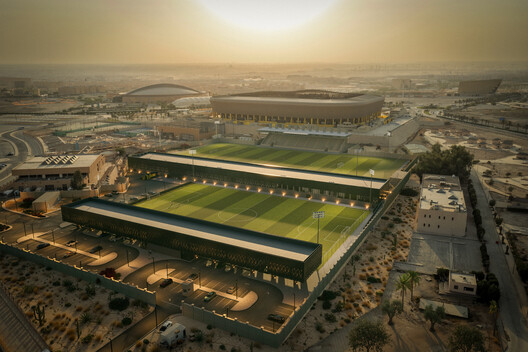
OODA announces the House of Nassr, a new integrated sports complex designed for Al Nassr FC in Riyadh, Saudi Arabia. Planned as a comprehensive facility supporting both athletic performance and club operations, the project brings together a high-performance training centre, administrative and media spaces, athlete support facilities, and social areas, with a hotel scheduled for a second phase of development. The complex occupies an area of approximately 4,000 square meters. While the overall project remains ongoing, the first phase has been completed in 2025, marking OODA's first realized project in Saudi Arabia.

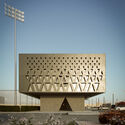
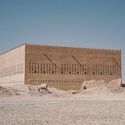
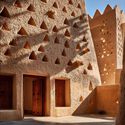
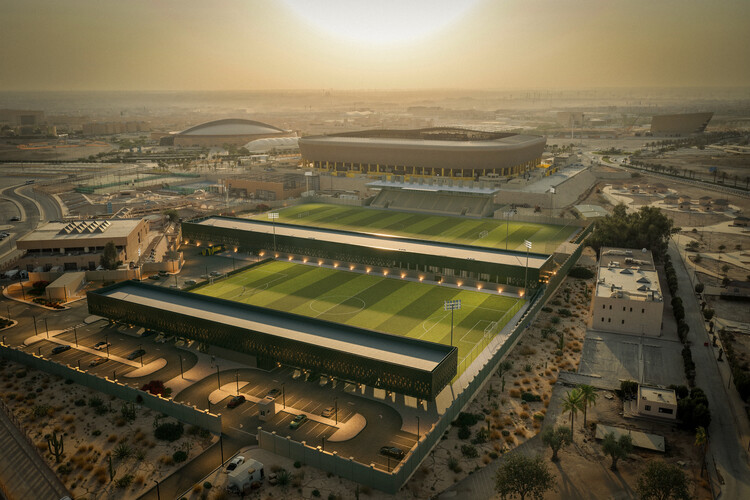
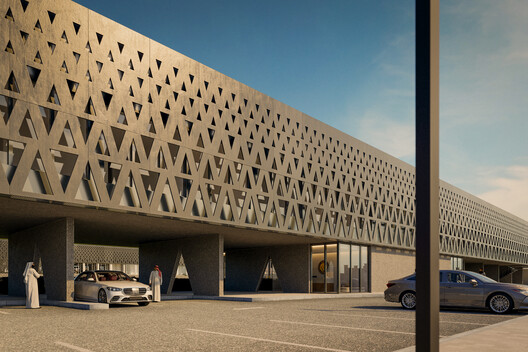
Conceived in response to the operational demands of professional football, the complex is organized to ensure functional proximity between programs, clear circulation, and a direct relationship with the training pitches. The architectural layout prioritizes efficient movement for athletes, staff, and media, while maintaining a clear distinction between public, semi-public, and restricted zones. Built volumes are arranged to establish continuous physical and visual connections with the playing fields, positioning training as the core of the project. The placement of access points, observation areas, and support spaces reinforces the close relationship between training, preparation, and performance.

The architectural expression of the House of Nassr is informed by an interpretation of Saudi vernacular architecture, translated into a contemporary language. This is articulated through the controlled use of light and shadow, rhythmic façade compositions, and a filtering envelope designed in response to local climatic conditions. These strategies contribute to environmental performance while aiming to establish a strong relationship with the surrounding context and the identity of the club. Through the House of Nassr, OODA extends its context-based approach to large-scale sports infrastructure in the Middle East, aligning spatial organization, climatic response, and institutional identity within a single architectural framework.
Related Article
Expo 2030 Riyadh Unveils First Details of Its Masterplan
In other recent sports complex developments, international practices continue to explore hybrid programs, large-scale regeneration, and alternative material strategies. MVRDV has won the international competition for Tirana's new Asllan Rusi Sports Palace, conceived as a mixed-use project titled The Grand Ballroom, which combines a 6,000-seat basketball and volleyball arena with residential units, a hotel, and ground-level retail. In the UK, Heatherwick Studio and MANICA Architecture have released designs for Birmingham City Football Club's new 62,000-seat stadium, planned for Bordesley Green as part of the wider Birmingham Sports Quarter redevelopment and aligned with the club's 150th anniversary. Meanwhile in Japan, VUILD has unveiled a timber stadium proposal for Fukushima United FC, referencing the Shikinen Sengu tradition to connect renewable materials, community participation, and contemporary sports infrastructure.